Recovery Alchemy with Dr. Dallas Bragg
My Story Free Course Meth-Free Blueprint EBook The Aftermeth Podcast Blog
← Back to all posts

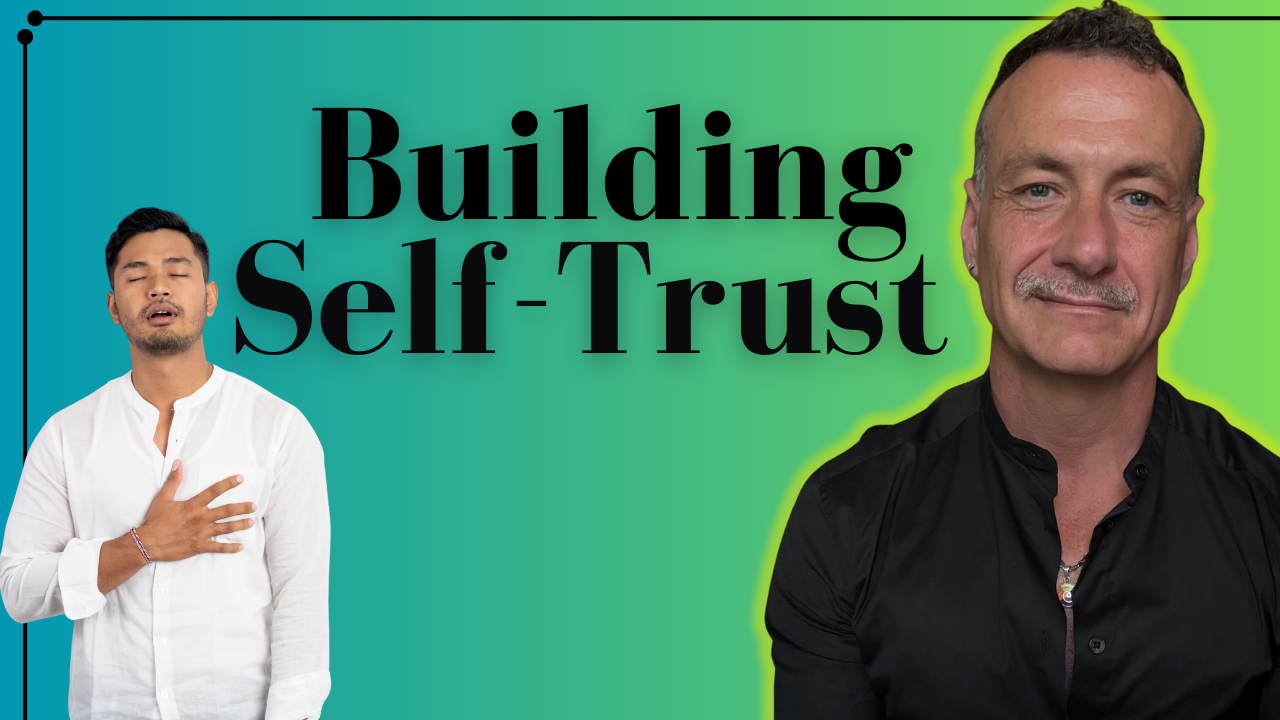
The Self-Trust Crisis (And Why You're Asking The Wrong Question)

by Dallas Bragg
Jan 12, 2026
Connect


"I don't trust myself."

One of the most common limiting beliefs I see among the men who come to me for help. Sometimes this is a literal spoken sentence, and other times it's a clear message based on behavior. 

Either way, it's rooted in shame and resignation, like it's an indictment of their character. Like they're fundamentally broken.

More evidence to support their "damaged goods" identity. 

Last week, a client sat across from me on Zoom, his face tight with frustration. "Dallas, I've been substance-free for two months, but I still don't trust myself. I'm terrified I'm going to fuck this up again. How can I move forward when I can't even trust my own decisions?"

I leaned forward. "What if I told you that you're asking the wrong question?"

He looked confused. "What do you mean?"

"When you say 'I don't trust myself,' you're treating yourself as a monolith—one unified entity that's either trustworthy or not.

Black or white. All or nothing. This is the thinking of someone with addictive patterns.

But that's not how your psyche actually works."

The real question isn't "Can I trust myself?"

It's "Which parts of me am I struggling to trust, and why?"

This reframe changes everything.

The Parts You Don't Trust

The first concept I want my clients - and you - to understand: you're not one singular self. You're a collection of parts, each with its own agenda, its own history, its own way of trying to keep you safe or get your needs met.

If you can conceptualize this, you can step out of the identification of labels such as "addict" in order to appreciate the true self underneath life's conditioning. 

And when you say "I don't trust myself," what you really mean is: "There are parts of me I don't trust."

Specifically? You don't trust the part who wants to engage in chemsex.

And I get it.

It's lied.

It's manipulated.

It's hurt people you love.

It's led you into some dark places. 

It's made promises it couldn't keep.

It's convinced you to prioritize getting high over everything else you claimed to value.
But here's the twist: the part who wants to use has always been trying to help you.

I know that sounds insane. But stay with me.

That part learned that crystal could provide what you desperately needed: confidence in sexual situations. Relief from shame. A feeling of belonging in spaces where you felt like an outsider. An escape from the relentless criticism in your own head. Connection when you felt profoundly alone.

Your meth-using part wasn't working against you. Its methods were just catastrophically misguided.

So instead of trying to eliminate or suppress this part (which never works), recovery is about integration.

It's about building a new relationship with your meth-using part through awareness and reprogramming.

Think about it this way: if your partner cheated on you but you decided to stay together and rebuild, what would that process look like?

Clear boundaries.

Regular check-ins.

You'd need transparency. 

Patience with the healing process.

Time to prove trustworthiness through consistent action.

A willingness to understand what drove the betrayal in the first place.

The same principles apply to your meth-using part.

And here's the empowering reframe: instead of "I can't trust my Addiction part," try this: "Parts of me have conflicting goals."

Suddenly, you're not a victim of your own mind.

You're the internal mediator. You're in the driver's seat, negotiating between parts, helping them find better ways to meet their needs.

Your meth-using part isn't working against you. Its efforts are just misguided, and now you're teaching it new strategies.

Trust Is Built On Evidence, Not Wishes

Let's get brutally practical.

You know why you don't trust yourself? Because your nervous system has mountains of evidence that you don't keep your word.

Every time you said, "This is the last time," and it wasn't.

Every promise you broke.

Every boundary you violated.

Every commitment you abandoned.

Your subconscious has been taking notes.

So when you try to white-knuckle your way into "trusting yourself again," it doesn't work. Because your system needs proof, not wishful thinking.

The good news is that evidence is something you can create.

It is never too late to reprogram the subconscious. 

One of the most powerful practices in my Recovery Alchemy program is what I call the 100-Day Habit. It's stupidly simple, which is exactly why it works.

Here's how it goes:

Choose ONE small promise to keep to yourself each day for 100 days. Document it in the morning. Reflect on it at night.

And when I say small, I mean ridiculously small. Like:

  • Drink a glass of water before noon
  • Make your bed
  • Five minutes of conscious breathing
  • Send one text to someone you care about

The size of the commitment matters less than the consistency of keeping it.

Because every single day you keep this promise, you're sending a message to your subconscious: My words carry weight. I am someone who follows through.

This is how you rebuild trust from the inside out.

But here's the key: you need to set up your life so that failing to complete this task is nearly impossible.

Don't choose "go to the gym" if you hate the gym.

Don't choose "meditate for 30 minutes" if you've never meditated before.

Choose something so small, so accessible, that you'd have to actively sabotage yourself to fail.

And here's another practice that supports this work: make a list of all the ways you currently DO trust yourself.

I'm serious. Right now, there are things you trust yourself to do consistently:

  • "I trust myself to brush my teeth every day."
  • "I trust myself to show up for work."
  • "I trust myself to feed myself when I'm hungry."

Start acknowledging this evidence.

Because when you only focus on where trust is broken, you miss all the places it already exists.

Recovery Isn't About Playing It Safe

Here's where most recovery programs get it completely wrong: they tell you to avoid risk, avoid triggers, avoid anything that might threaten your sobriety.

But here's what I know after seven years in recovery and hundreds of clients: you don't build trust by hiding. You build it by proving you can navigate discomfort without crystal.

What would recovery be without triggers? Just a rainbow walk in the park? What would you gain from that?

Crystal was never about the drug.

It was about what the drug did for you.

The confidence.

The connection.

The escape.

The intensity.

The permission to be sexual.

The relief from anxiety.

Now you need to prove to yourself that you can access those experiences—or at least survive the absence of them—without crystal.

This is where calculated risk-taking becomes essential.

Let me be clear: I'm not talking about reckless behavior. I'm talking about graduated exposure to situations that challenge your recovery while you have support systems in place.

Every time you take a calculated risk and emerge on the other side still intact, you're building a library of evidence that you can trust yourself.

Here's the framework:

Step 1: Identify Your Edge

Where does safety end and growth begin? Make a list of situations that feel mildly, moderately, and intensely challenging to your recovery.

Start with the mild ones. Maybe it's:

  • Going to a gay bar sober with a trusted friend
  • Attending a circuit party with clear boundaries and an exit plan
  • Having a difficult conversation without numbing afterward
  • Going on a date and being honest about your recovery

Step 2: Prepare Strategically

Before taking any risk, create a detailed safety plan:

  • Who will be your support person on standby?
  • What exact phrases will you use if you need to exit?
  • What self-regulation tools will you bring (grounding objects, mantras, breathing techniques)?
  • What's your exit strategy if triggers intensify?

Step 3: Document Before, During, After

Before: "What am I afraid might happen? What strengths can I draw on?" During: Note physical sensations, thoughts, urges (quick voice memos work well) After: "What surprised me? What did I learn about my capacity?"

This documentation is crucial because your brain will try to minimize your victories. By recording them, you create undeniable evidence of your growing capacity.

Each risk you navigate successfully rewrites the story you tell yourself about who you are and what you're capable of.

The Truth About Trust

Listen: The goal isn't to become someone who never doubts themselves. The goal is to become someone who understands that doubt is just one part of you speaking—not the whole truth.

You're not broken. You're not untrustworthy. You're a complex human being with multiple parts that have been trying to keep you safe in the only ways they knew how. Some of those ways involved crystal. Now you're learning new ways.

Trust isn't something you either have or don't have. It's something you build, brick by brick, promise by promise, risk by risk, boundary by boundary.

The evidence is waiting for you to create it.

Start today.

— Dallas 


The Seven-Day Trust Experiment

Alright, enough theory. Let's make this real.

For the next seven days, I'm challenging you to practice ALL FOUR trust-building strategies we've covered:

Day 1-7: The Four Pillars

1. Parts Work: Each morning, check in with your Addiction part. Ask: "What do you need today?" Listen without judgment. Maybe it needs reassurance. Maybe it needs permission to rest. Maybe it needs to know you're not trying to eliminate it.

2. Habit Evidence: Choose ONE tiny promise. Make your bed. Drink water before coffee. Two-minute meditation. Track it daily in your phone or a journal.

3. Calculated Risk: By day three, identify ONE edge situation. A challenging conversation. A triggering location. A vulnerable disclosure. Prepare your safety plan. Take the risk by day seven. Document your before/during/after experience.

4. Boundary Practice: State ONE clear boundary this week, even if it's uncomfortable. "I'm not discussing my recovery choices." "I need you to let me know if substances will be present." "I'm leaving at 10pm." Enforce it if tested.

Track your observations. By day seven, answer: What surprised me most about my capacity to trust myself?

Five Reflective Questions

Before you close this email, sit with these:

  1. Which specific part of me am I struggling to trust, and what is that part actually trying to protect or provide for me?

  2. What is one ridiculously small promise I can make to myself today and keep for the next 100 days?

  3. What calculated risk could I take this week that would prove I can handle discomfort without crystal?

  4. What boundary have I been avoiding setting because I'm afraid of others' reactions?

  5. What evidence do I already have that parts of me ARE trustworthy?


Responses

Join the conversation
t("newsletters.loading")
Loading...
Mindful Masturbation: Reclaiming Pleasure in Recovery A Conversation with Coach Kevin Martin (The Pleasure Priest)
    When I think about the most underserved areas of recovery support, sexual reintegration sits right at the top. We talk endlessly about staying clean, managing cravings, rebuilding relationships with family and friends—but we rarely discuss how to rebuild the relationship with our own bodies and sexuality. For those of us coming out of chemsex, this gap feels especially profound. Quitting m...
Understanding Boundaries (And Self-Betrayal)
  One of the greatest gifts crystal methamphetamine gave me was the understanding of boundaries. I wasn't shown boundaries as a child.  I never knew how to create boundaries as an adult. And in my active meth use, that gap in understanding was exploited by the chemical. For example, whenever someone asked me what I was into sexually, I would answer with another question: What are YOU into?  I ...
Understanding Loneliness: From Isolation to Meaningful Connection
  Hey everyone, Loneliness. It's one of those words we throw around constantly in recovery circles—right up there with "connection" and "self-care." But what does it actually mean? And more importantly, what do we do about it? Here's what I know from working with hundreds of men in recovery: loneliness is consistently one of the top three reasons people relapse. It's that Friday night feeling ...

Blog

© 2026 Coaching with Dr. Dallas Bragg | Website by LlanoMedia.com

Join The FREE Challenge

Enter your details below to join the challenge.