
You've been holding it together. Doing the work. Showing up. And then one day, out of nowhere, something in you just quits — and everything you've been building disappears in an instant.
Maybe it was a conversation that didn't go the way you hoped.
Maybe it was a promotion at work, a recovery milestone, a fight with a family member, or just too many days of holding it all together without anywhere to put it down.
And then: fuck it.
Everything you've built — the tools, the awareness, the commitment — gone.
Not because you didn't care.
Not because recovery doesn't matter to you.
But because the pressure had been building quietly, without release, and the only exit valve your nervous system could find was surrender.
This is what we call the fuck-its.
And it's more predictable than you think.
Here's what I want you to understand before we go any further: the fuck-its are not a character flaw.
They are not proof that you're broken, that this doesn't work for you, or that you're destined to stay stuck.
They are a nervous system event.
A physiological response to accumulated emotional pressure that never found a release. And because it's physiological, it's also preventable — if you know what to look for and when to act.
That's what this newsletter is about.
The Pressure Cooker You Didn't Know Was On
Think about your emotional life like a pressure cooker.
Every activation — every stressor, every trigger, every moment of joy or grief or rage or disappointment — adds heat.
Add enough heat without a release valve, and the system eventually fails.
What makes this so tricky is that most of us were never taught to maintain the release valve.
We were taught to manage.
To contain.
To keep it together.
So instead of letting small amounts of pressure out consistently, we hold it, compress it, rationalize it — until something cracks.
Research on relapse tells us that by the time someone physically uses, the decision was already made weeks or even months earlier.
Not consciously — but neurologically.
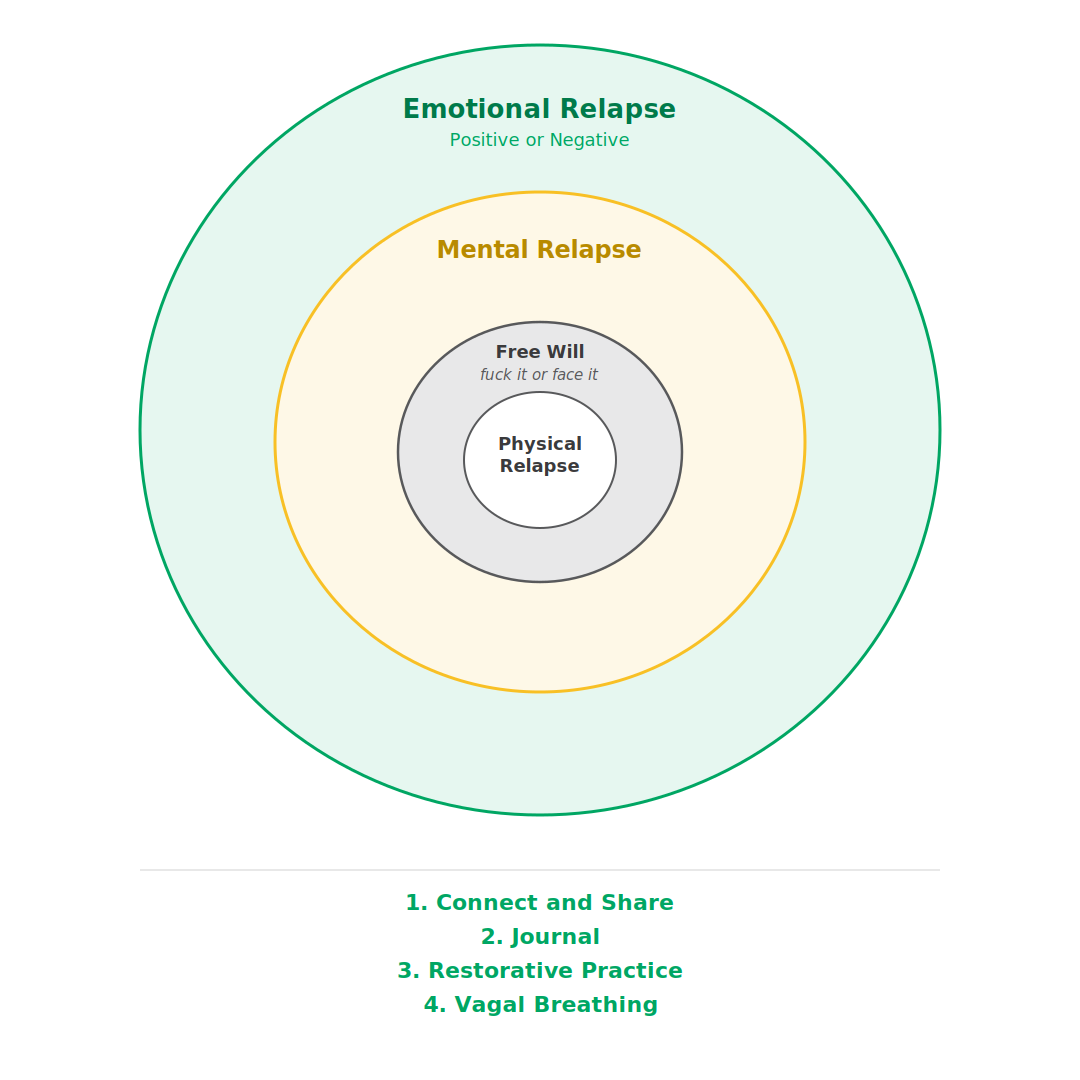
The process begins with what clinicians call emotional relapse: that stage where you're not actively thinking about using, but your emotions and behaviors are quietly setting up the conditions for it.
You're isolating more. You're not reaching out. You're dismissing small activations as not a big deal.
Nothing is obviously wrong. But the pressure is building.
From there, it moves into mental relapse — where the bargaining begins.
Maybe just once. Maybe I've earned it. Maybe it wouldn't be that bad.
The fantasizing. The planning. The romanticizing.
And finally: physical relapse. The fuck-its made manifest.
Here's what matters most: intervention works best at the emotional stage, before momentum builds.
Once the train starts moving, it gets harder and harder to stop. The goal isn't to be heroic when you're already in mental relapse. The goal is to notice the heat rising and open the valve before the whole system tips.
Below is a model I created to help explain this process.
Notice that the free will circle, where you are called upon to make the decision, you can give in to the fuck-it's or you can face it.
Facing it means leaning into the tension, the anxiety, the uncomfortable feelings, the intensity of the moment, and doing nothing but feeling it fully. Feeling is healing. Which will be covered later.
The coping mechanisms at the bottom will be explained below.
Positive Activation Is Still Activation
We tend to think about triggers as dark things.
Hard things.
The argument with the family member.
The rejection.
The shame spiral.
The loneliness.
But the fuck-its can come just as easily from what's going right.
A milestone in your recovery.
A promotion at work.
Things finally clicking into place.
Life opening up in ways you've been hoping for.
These moments activate the dopamine reward circuits in your brain — the same circuits that addiction rewired.
The celebration impulse, the urge to mark the moment, the I've been so good, I deserve this — it hits those same pathways.
The neurochemistry doesn't distinguish between good news and bad news. It just responds to activation.
This means your nervous system needs tending whether you're in crisis or in celebration. Whether you're breaking down or leveling up.
The four strategies below work for both.
Four Ways to Stay Ahead of the Fuck-Its
One: Notice Everything — And Tell Someone
The first line of defense is awareness without dismissal.
And I want to emphasize that second part, because we are remarkably good at talking ourselves out of our own experience.
Road rage.
A spike of anxiety watching the news.
Irritability after a phone call with your mother.
An electric, giddy feeling after landing a big win.
All of it counts. None of it is too small.
Every emotional activation — positive or negative — is information your nervous system is giving you, and it all connects to the same pressure system.
The moment you notice activation, your job is simple: tell someone.
Text your coach.
Message your group.
Call a friend.
This is not just emotional support — it is neurochemistry.
Research shows that genuine social connection triggers the release of oxytocin, a neuropeptide that directly counters the stress response and has been shown to reduce craving and drug-seeking behavior in recovery.
Connection doesn't just feel good. It biochemically interrupts the pressure before it compounds.
Don't sit with it alone.
Two: Write It Down
Journaling is one of the most underestimated tools in recovery — and the research behind it is genuinely remarkable.
When you put your feelings into words on paper, your brain does something specific: it activates the prefrontal cortex — the part responsible for reasoning, decision-making, and emotional regulation — while simultaneously calming the amygdala, which is your brain's alarm system.
In simple terms, writing shifts your experience from your reactive brain into your thinking brain.
That's not a metaphor.
That's what's happening in your nervous system when you journal.
Research by Dr. James Pennebaker and colleagues has shown that people who engage in expressive writing experience reduced anxiety, lower cortisol levels, improved immune function, and stronger emotional resilience over time.
Your journal is not a diary. It's a pressure release valve and a pattern tracker. Over time, you'll see exactly what activates you — and you'll be able to prepare.
Three: Deploy Your Restorative Practice — That Same Day
Every person reading this has something that restores them.
Movement.
Nature.
Music.
Time in solitude.
Creative work.
A long shower.
Whatever it is for you, it needs to be identified before you need it — and deployed the same day you feel activated.
Not tomorrow. Not after the weekend. That day. As soon as possible.
Here's why the timing matters: your nervous system doesn't reset on a delay.
When activation goes unaddressed, it compounds.
One day of held tension becomes two, becomes a week, becomes a baseline level of dysregulation you've stopped noticing because it feels normal.
The restorative practice — deployed same-day — keeps your system balanced before the pressure can accumulate.
And there's deeper science here too.
Research has found that aerobic exercise can help normalize dopamine signaling that has been disrupted by substance use.
Your body's natural movement and restoration aren't just self-care. They're a neurological reset of the same reward circuitry that addiction hijacks.
Know your practice. Use it the same day. Every time.
Four: Vagal Breathing to Regulate Your Nervous System
Your vagus nerve runs from your brainstem through your heart, lungs, and gut — and it is your body's most direct pathway to calm.
When you breathe slowly, with a longer exhale than inhale, you stimulate this nerve and signal your parasympathetic nervous system — your body's rest and digest mode — to activate.
Research consistently shows that slow diaphragmatic breathing with extended exhalation activates the vagus nerve, reduces cortisol, lowers heart rate, and shifts the body out of fight-or-flight.
Studies also show that conscious breathing practices help regulate dopamine — supporting balance in your reward circuits rather than letting them spike unchecked in either direction, whether you're crashing from stress or riding high from a win.
The practice is simple: inhale for a count of four. Exhale for a count of six or eight. Repeat for two to five minutes.
That's it. It's free. It works fast. And it is one of the most evidence-backed tools available to you every single day.
You are not at the mercy of your nervous system.
You are the executive of your own recovery — and executives prepare before the crisis, not during it.
The awareness, the connection, the journaling, the restoration, the breathing — these are not extras. They are the infrastructure of a life that doesn't break under pressure.
Start today. Before the heat rises.
Love, Dallas
Reflective Questions
Take some time to sit with these. There are no right answers — only honest ones.
- When was the last time you felt the fuck-its creeping in? What had been building in the weeks before that moment?
- Do you tend to dismiss small activations as "not a big deal"? What do you tell yourself to justify not reaching out?
- What positive life events or milestones have activated you recently? Did you treat those with the same care you'd give a difficult trigger?
- Are you currently in emotional relapse — not thinking about using, but noticing your emotions and behaviors setting conditions for something?
- What does your nervous system feel like right now, in this moment? Where are you holding tension?
Journal Prompts
Set aside 15–20 minutes with these. Write without editing yourself.
- Describe the last time you got the fuck-its, or came close. Walk through what was building in the days or weeks before. What were the early signs you missed or dismissed?
- Make a list of your top five emotional activation points — the people, situations, or events (positive or negative) that reliably move your nervous system. What patterns do you notice?
- Write about a time things were going really well in your life or recovery. Did you tend to that activation with the same care you'd give a crisis? What would have been different if you had?
- What is your restorative practice right now? Be specific. If you don't have one, write about what restoration has felt like in your past and what might be available to you now.
- Write a letter from your future self — the version of you who has mastered the art of maintaining the pressure valve. What do they want you to know about catching it early?
This Week's Actionable Exercise: Build Your Fuck-Its Prevention Plan
This week, create a one-page personal prevention plan using these four prompts:
My top three activation points (the people, situations, or events — positive or negative — that most reliably activate my nervous system):
My go-to person to reach out to when I feel activated (name and how I'll contact them):
My restorative practice and the specific commitment: When I feel activated, I will do __________ that same day, before __________ o'clock.
My vagal breathing reminder: I will practice for two minutes every __________ (time of day), and also anytime I feel activation rising.
Keep this somewhere you'll see it. Not in a folder. On your bathroom mirror, in your notes app, somewhere in your line of sight.
The fuck-its don't win because you're weak. They win because you didn't have a plan before the pressure built. Now you do.


Responses