Hey y'all,
Breaking free of the notion that recovery (or healing or life in general) is a linear process was the most impactful perspective shift of my journey.
When I viewed the process as a spiral, it created space for self-compassion, awareness, and a deeper level of preparedness.
When you drop the need to follow a linear path of steps, you aren't mired in doubt and self-shame when so-called failure comes.
In the spiral model, there is no failure. Only a return to the same experience in order to engage in another layer of knowledge.
Knowledge is power when you are trying to break free from the addictive patterns of chemsex.
Many think they can get through the detox, go to meetings, work the steps, stay busy, be coached, show up to therapy, and boom—life gets better and better, right?
Wrong.
What actually happened to me was a chaotic spiral, where some weeks I felt like a superhero, and other weeks I couldn't understand why getting out of bed felt like climbing Everest.
Some days the resolve was rock-solid, and others I was white-knuckling my way through the most mundane Tuesday afternoon you could imagine.
I thought I was doing recovery wrong.
I thought something was broken in me that wasn't broken in other people.
What I didn't know—what nobody told me—is that this spiral is the recovery.
Over my seven years meth-free and working with many gay men in recovery, I've watched this same pattern play out again and again. It's so predictable that I literally drew it out as a map.
This is the 12-Week Upward Spiral, and understanding it might be the difference between making it through your first 90 days and becoming another statistic.
Because here's what I know: you can't successfully navigate terrain you don't understand.
And if nobody's warned you that week seven is going to feel like you're drowning in quicksand, you're going to think you're failing when you're actually right on track.
So let's talk about what actually happens in those first 12 weeks—the phases nobody mentions in meetings, the predictable patterns that traditional recovery doesn't prepare you for, and most importantly, how to proactively plan for each stage so you don't get lost in it.
Disclaimer: This spiral process isn't the exact same journey for every person, nor does it necessarily have to be in consecutive order. Avoid all-or-nothing thinking when conceptualizing this process. Each man who embarks on this journey brings variations and context that can alter these 12-week phases. This is an overall process that I've witnessed, not the rule of law.
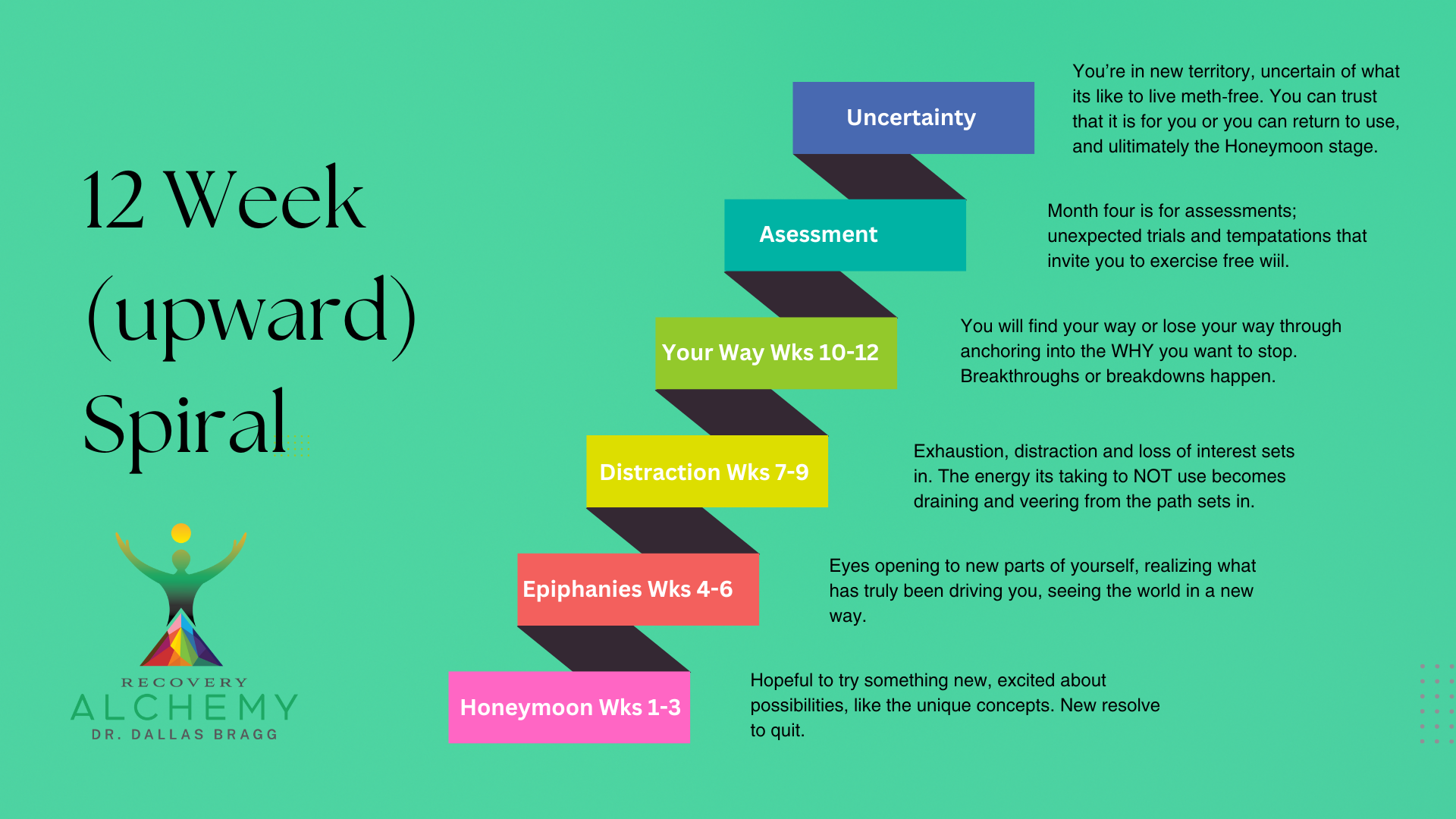
The Honeymoon Phase: Weeks 1-3
"Hopeful to try something new, excited about possibilities, like the unique concepts. New resolve to quit."
Let's start here: those first three weeks often feel utterly amazing.
You're done. Finally done.
You've made the decision, and suddenly the world looks different.
You're reading recovery books, listening to podcasts, maybe you've found a therapist or coach who actually gets it. You're journaling, you're attending meetings, and you're sharing everything with your accountability partner.
The concepts in recovery feel fresh and exciting.
You're learning about triggers and patterns. You're discovering that other gay men have gone through exactly what you've gone through. You're not alone anymore, and that realization is intoxicating in its own right.
This is the phase where you buy the gym membership, clean out your apartment, delete Grindr for the 47th time (but this time it's different), and maybe even post something vague on Instagram about "new chapters."
Your energy is high. Your resolve is real. The decision to stop feels solid.
And then you make a critical mistake: you think it's going to stay this way.
What's Actually Happening
Your brain is flooding with relief.
The shame spiral has stopped.
The physical detox is subsiding.
You're sleeping more than three hours a night. Your body is remembering what it feels like to eat real food and drink water.
This biochemical relief combined with the psychological relief of making a decision creates a genuine high.
It's real—but it's also temporary.
The danger of the Honeymoon Phase isn't that it feels good. The danger is that you'll mistake this initial surge of motivation for permanent transformation. You'll think, "Oh, I've got this," and you'll let your guard down.
The Proactive Strategy
1. Document everything. Write down exactly how you feel right now. Capture this resolve in as much detail as possible. When week seven hits and you can't remember why you ever wanted to quit in the first place, you'll need these words.
2. Build your systems NOW while you have energy. This is the time to set up every barrier, every accountability structure, every support system you can think of. Don't wait until you "need" them. You're going to need them most when you have the least energy to create them.
3. Study your patterns. Use this high-functioning time to do deep work on your euphoric recall. Map out your triggers. Identify your danger zones. Create your relapse prevention plan. Do this work now because in a few weeks, you won't have the cognitive bandwidth.
4. Prepare yourself for the drop. Tell your accountability partner: "In a few weeks, I'm probably going to feel very different than I do right now. I'm going to need you to remind me of this conversation."
Journal Prompt
- Write a letter to your future self in week seven. Tell yourself why you stopped. Describe in vivid detail the last time you used—the shame, the consequences, the moment you decided enough was enough. Be specific. This letter is going to save your life.