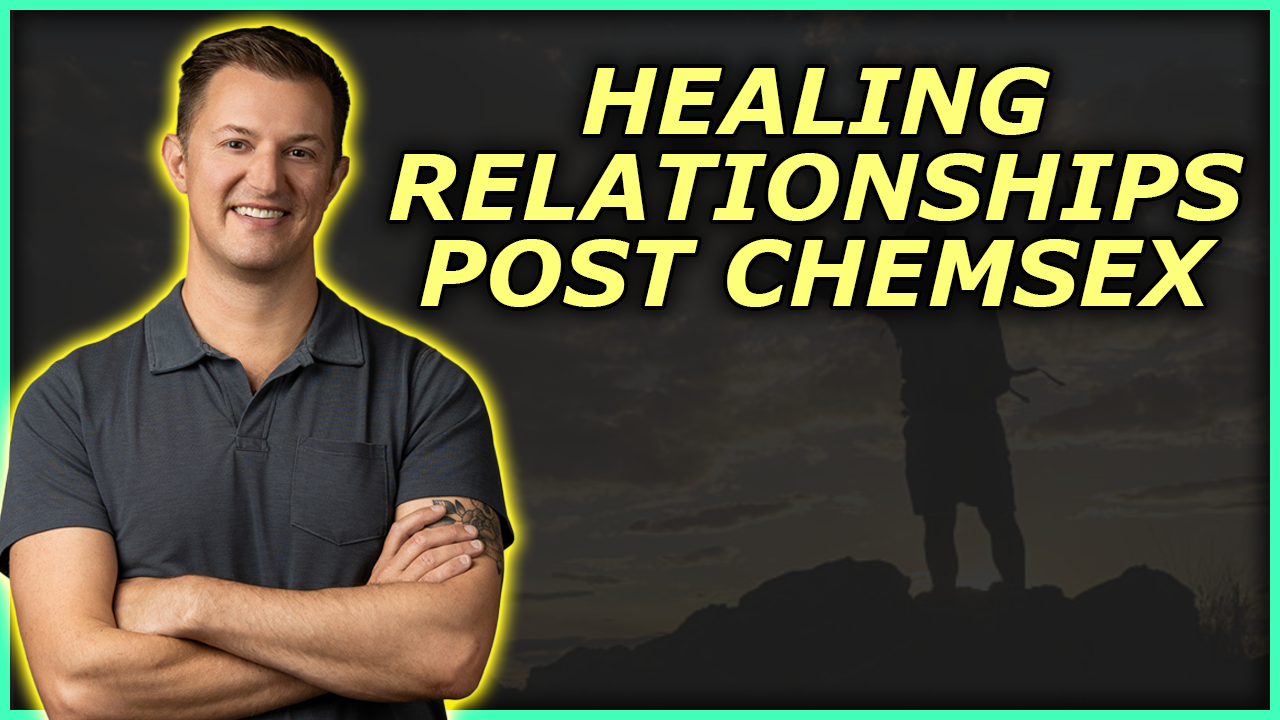
When I think about the couples I've worked with who are navigating chemsex addiction, I'm reminded of just how layered and complex this work truly is. One partner is fighting to reclaim their life from methamphetamine, while the other is trying to hold on to the person they fell in love with—someone who seems to be disappearing before their eyes. It's heartbreaking, and it requires an immense amount of courage from both people.
That's why I was so excited to sit down with Tom Bruett, a licensed marriage and family therapist and certified sex therapist who specializes in working with queer relationships. Tom brings a depth of expertise that I simply don't have, and his insights into attachment theory, trust rebuilding, and sexual reintegration are invaluable for anyone navigating this journey—whether you're the person in recovery or the partner standing beside them.
This conversation isn't easy, and frankly, it shouldn't be. The work of healing a relationship impacted by chemsex is some of the heaviest lifting you'll ever do. But as Tom reminds us, there is hope. Couples can and do work through this, but only when both people are willing to do the hard work, seek support, and face the uncomfortable truths together.
When Meth Becomes the Third Person in Your Relationship
Tom introduces a concept that hit me hard: when someone is actively using methamphetamine, meth becomes their primary attachment object. In essence, there are three people in the relationship—you, your partner, and the drug. And here's the devastating truth: as humans, we can never compete with the power and allure of meth.
Attachment science, which originally studied caregiver-child relationships, shows us that we seek connection and safety from the people we're attached to. But when meth enters the picture, it hijacks that attachment system. The drug becomes the thing that soothes, excites, and fulfills—leaving the partner feeling abandoned, betrayed, and secondary.
Reflection Question: If meth has been part of your relationship, can you identify moments when the drug felt like a third person? How did that impact your sense of connection with your partner?
For the person using, this might mean recognizing that your relationship with meth—whether anxious, avoidant, or disorganized—mirrors how you attach to people. Are you constantly thinking about when you'll use next? Do you compartmentalize it, telling yourself you have it under control? Understanding your attachment style with the substance can offer insight into the deeper work you need to do.
For the partner who isn't using, this realization can be both validating and devastating. You're not imagining it—you are competing with something more powerful than yourself. And that's not a competition you can win until your partner decides they want to heal their relationship with meth.
Journal Prompt: Write about a time when you felt like you were competing for attention, connection, or priority in your relationship. What emotions came up for you? What did you need in that moment that you didn't receive?
Honesty: The Foundation You Must Rebuild
Tom emphasizes that honesty is the absolute foundation for any healing to occur. And this is where things get really uncomfortable. For the person using, the fear of being honest is often rooted in shame, fear of abandonment, or the belief that their partner will leave if they know the full truth. But here's what Tom makes clear: the slow drip of dishonesty—where truth comes out piece by piece, each revelation another paper cut—is far more damaging than one painful, honest conversation.
I've seen this with my own clients. The partner who isn't using often says, "It's not even the drug use that hurts the most—it's the lying." When trust is shattered, everything becomes questionable. What else haven't they told me? Can I believe anything they say?
Rebuilding trust requires the person in recovery to bring their partner into the fold. This means sharing the uncomfortable stuff: "I almost used last night. I was on Grindr looking at profiles. I watched porn that triggered me." These small moments of vulnerability, while painful, are what slowly rebuild the foundation of trust.
Action Exercise: If you're in recovery, identify one thing you've been avoiding sharing with your partner because of shame or fear. Write it down. Then, when you're ready, practice saying it out loud—first to yourself, then to your partner. Notice what comes up for you.
For the partner who isn't using, your role is to create space for honesty without immediate judgment or punishment. That doesn't mean you can't have feelings about what you hear—you absolutely should—but it means recognizing that honesty is a gift, even when it hurts.
Reflection Question: What would it take for you to feel safe being fully honest with your partner? Or, if you're the non-using partner, what would help you hold space for difficult truths?
The Partner Who Isn't Using Needs Support Too
One of the most important points Tom makes is this: if you're the partner who isn't using, you need support. This isn't something you can white-knuckle your way through alone. Discovering that your partner is involved in chemsex can be deeply traumatizing, especially if you had no previous experience with meth or the chemsex scene.
You didn't sign up for this. You fell in love with someone, and now you're dealing with betrayal, lying, and watching someone you love disappear into addiction. That's a trauma response, and it deserves to be treated as such.
Tom suggests finding a therapist, coach, or support group where you can process your experience with people who understand. You need someone who can normalize what you're going through, educate you about chemsex and meth addiction, and help you navigate the very real grief and loss you're experiencing.
Action Exercise: If you're the non-using partner, research three potential sources of support this week—a therapist who specializes in addiction, a support group for partners of people in recovery, or a coaching program. Reach out to at least one.
And just like you would educate yourself about depression if your partner was struggling with mental health, you need to educate yourself about meth and chemsex. Listen to podcasts, watch documentaries, read articles. Understanding what your partner is facing doesn't excuse their behavior, but it does give you context for the battle they're fighting.
Journal Prompt: What emotions are you carrying right now that you haven't fully acknowledged or expressed? Write them all down—anger, grief, betrayal, love, exhaustion, hope. Let yourself feel them without judgment.
Setting Boundaries Is an Act of Love
This is one of the hardest lessons for partners to learn: setting a boundary and holding it is not cruel—it's an act of love, both for yourself and for your partner. Tom is clear about this: if you set a boundary, you must follow through. If you say, "If you use again, I'm leaving," and then you don't leave, your partner learns that your boundaries are negotiable.
I know this is easier said than done. You love this person. You've built a life together. You believe that if you can just solve the meth problem, everything will be okay. But here's the truth Tom shares: meth is often a symptom of deeper issues. And until those issues are addressed, the cycle will continue.
Reflection Question: Have you set boundaries in your relationship that you didn't hold? What stopped you from following through? What would it take for you to honor your own boundaries?
Setting a boundary might feel like you're abandoning your partner, but sometimes loving someone means saying no. It means refusing to enable their addiction. It means walking away so they can hit a bottom that might finally motivate them to seek help.
For the person in recovery, your partner setting a boundary might feel devastating—but it can also be the wake-up call you need. If your partner leaves, it's not because they don't love you. It's because they love themselves enough to stop participating in a cycle that's destroying both of you.
Action Exercise: Write down three non-negotiable boundaries you need in your relationship. Be specific. Then, communicate them clearly to your partner. If you're not ready to communicate them yet, share them with a therapist or trusted friend first.
Sexual Reintegration: Expanding What Sex Means
One of the questions I get asked most frequently is: "How do we have sex again after chemsex?" And Tom's answer is both realistic and hopeful. He doesn't promise a quick fix or a return to exactly what sex was before. Instead, he invites couples to expand their understanding of what sex and intimacy can be.
For many gay men, sex has a very narrow definition: anal penetration, big orgasms, simultaneous climax. But what if sex could be something broader? What if it started with erotic massage, with no expectation of arousal? What if it was holding hands while watching something sexy together? What if it was about being embodied with another person, exploring pleasure slowly, without the pressure of performance?
Tom emphasizes that there's a grieving process here. The person in recovery has to grieve the version of themselves they experienced on meth—the uninhibited, sexually confident person they always wanted to be. The partner has to grieve the sex life they once had. Both people have to accept that rebuilding intimacy is like rebuilding after a fire: you start with the foundation, then the walls, then the finishing touches. It's a process.
Journal Prompt: What do you need to grieve about your sexual relationship? What have you lost, and what are you afraid you'll never get back? Allow yourself to mourn those losses.
For some people in recovery, the challenge is that they're no longer attracted to their partner. Tom encourages curiosity here: What does that mean? Has your partner become a caretaker rather than a lover? Have you discovered new kinks or fetishes that feel intrinsically linked to your sexuality now? Are you still dealing with the neurological changes meth caused?
These are complex questions, and they don't have easy answers. But they're worth exploring with honesty and patience.
Reflection Question: If you're in recovery, what would help you feel safe reconnecting sexually with your partner? If you're the non-using partner, what would help you feel desired and connected again?
Action Exercise: Together, create a "pleasure menu" that has nothing to do with penetrative sex. Include things like massage, kissing, bathing together, reading erotica aloud, or simply cuddling while watching something sexy. Try one item from the menu this week with no expectation of where it leads.
The Stages of Gay Relationships: Where Are You Now?
One of the most valuable frameworks Tom offers in his book, The Go-To Relationship Guide for Gay Men, is his outline of the stages gay relationships move through. Understanding where you are can help you identify what work needs to happen next.
Stage 1: The Second Queer Adolescence – Many gay men didn't get to experience a typical adolescence where they explored their sexuality and identity. This stage is about experimentation, growth, and learning who you are. If you didn't have this period when you came out, you might experience it later in life—or even while in a relationship.
Stage 2: The Honeymoon Stage – This is the bonding period, usually lasting six months to two years, where you're evaluating compatibility. You think about your partner constantly, have great sex, and spend all your time together.
Stage 3: Discovering Differences – After the honeymoon wanes, you reconnect with yourself and discover differences between you and your partner. This is where topics like open relationships, different sexual desires, or reconnecting with hobbies often emerge.
Stage 4: The Exploration Stage – Can you go out and explore those differences while maintaining the relationship? This requires trust, communication, and a willingness to let your partner be an individual.
Stage 5: The Agreement Stage – After exploration, it's critical to verbalize agreements. Most conflicts happen when there are unspoken expectations.
Stage 6: The Reconnection Stage – After exploring individually, do you intentionally reinvest in the relationship? Many couples forget this step.
Stage 7: Mutual Interdependence – This is the goal: the ability to move fluidly between being a couple and being individuals, with both connection and autonomy.
If chemsex has disrupted your relationship, you may need to go back to Stage 1 or 2 and essentially start over. That's not a failure—it's a recognition that the foundation cracked and needs to be rebuilt.
Reflection Question: Which stage do you think you and your partner are in right now? What work does that stage require, and are you both willing to do it?
Action Exercise: If you have Tom's book, read the chapter on your current stage together. Discuss what resonates and what feels challenging. If you don't have the book yet, consider getting it—it's a practical, compassionate guide for exactly this kind of work.
When Meth Is a Symptom, Not the Problem
Tom says something that I think is crucial for everyone to hear: meth is often a symptom of deeper issues. Yes, some people experiment and become addicted, but usually, there's something underneath—trauma, low self-esteem, unresolved pain, internalized homophobia. Until those root causes are addressed, simply removing the meth won't fix the relationship.
I've seen this with my own clients. They stop using, and suddenly all the issues that were buried under the addiction come rushing to the surface. Maybe the relationship wasn't working before the meth. Maybe there were communication problems, mismatched desires, or unresolved resentments. The meth just masked them.
This is why individual work is so important for both partners. The person in recovery needs to understand what drove them to meth in the first place. The partner who isn't using needs to explore their own patterns—codependency, fear of abandonment, the need to be needed.
Journal Prompt: What was happening in your life or relationship before meth became a problem? Were there issues you were avoiding? Feelings you weren't expressing? Write honestly about what might have been underneath the surface.
Action Exercise: Both partners should commit to individual therapy or coaching alongside any couples work. Healing the relationship requires healing yourselves first.
There Is Hope, But Only If Both People Are Willing
Tom shares that the couples who successfully navigate chemsex recovery have a few things in common: honesty, even when it hurts; the person using isn't using heavily or is willing to go to rehab; and both people are committed to doing the hard work.
But here's what Tom also says, and I think it's important: if your partner is actively using meth multiple days a week, you're essentially alone. You can't build a deep, trusting, emotionally connected partnership with someone whose primary attachment is to a substance. It's just not possible.
That doesn't mean the relationship is over forever. But it does mean that meaningful change can't happen until the person using decides they want something different. And sometimes, the most loving thing you can do—for both yourself and your partner—is to walk away.
Reflection Question: If you're the non-using partner, are you willing to stay in this relationship long-term if things don't change? If you're in recovery, are you willing to do the deep, uncomfortable work required to heal?
As I reflect on this conversation with Tom, I'm struck by just how heavy this work is. Relationships are already complicated, and when you add the devastation of chemsex addiction into the mix, it can feel impossible. But Tom reminds us that there is hope. Couples can work through this. But only if both people are willing to be honest, seek support, and commit to the long, slow process of rebuilding.
If you're in the middle of this right now—whether you're the person in recovery or the partner trying to hold on—please know that you don't have to do this alone. Reach out for help. Find a therapist, a coach, a support group. Read Tom's book. Listen to this podcast again. Take one small step forward today, and then another tomorrow.
You deserve a relationship built on trust, honesty, and genuine connection. And your partner does too. But first, you both have to be willing to do the work.
If you want to learn more about Tom's work, visit his website at www.queerrelationshipinstitute.com or follow him on Instagram @queerrelationshipinstitute. His book, The Go-To Relationship Guide for Gay Men: From Honeymoon to Lasting Commitment, is available wherever books are sold, and I highly recommend it.
And as always, if you need support in your own recovery journey, visit my website at www.drdallasbragg.com to learn more about coaching options.
Love you all. 💚
Dallas


Responses